Why are Bankers Richer Than You??

The title doesn’t seem like a good question?

Not a 5 star hotel, It is Mauritius Commercial Bank

Let’s consider this, all the money a bank has, comes from its costumers or the central bank(which they have to repay) yet bankers are one of the highest paid individuals in the world, the infrastructure of banks are better than majority of corporations.

Still doesn’t sound amusing?

Let’s say you are the only customer of a bank (hypothetically of course). All the money you earn goes to bank. But, over a peroid of time the bank become richer than you.

WTH

WTH? Why? How?

A bank charges its customers fees for everything( pretty much ) from transactions of huge sums, putting money in various funds( mutual funds, pension funds, etc). taking money out of the funds, online payments fees, etc.

For example – When(if) you go to a bank for investing in a mutual fund, you will be handed a books of hundreds of pages which is filled with complex economical words which look may like a witch’s spell. Here’s a free tip to cut for you through the mud, every time you see the words cost, fees(management fees, transaction fees, etc), (which will be in percentages) this is amount that will be taken from your pocket other than the actual investment. (usually ranges between 20% – 40%)

What does this mean?

This simply means that, even if all your money is lost the bank will still make a good bit depending on the amount of your investment.

  • F.Y.I the total amount in mutual funds in U.S.A alone is $5 Trillion i.e almost 5 times of Pakistan’s G.D.P ($1.202 trillion……Wikipedia).

Moreover there are interests on loans given.
Wow that sounds like a lot income for the banks.

Yes, but that’s not their biggest source of income. (According to me)

The below information is more of my personal theory (so take it with a grain of salt) and there ain’t any official numbers to this.

Let us say you live India, the INFLATION is 8% (quarterly). You keep some amount in a saving account, the interest you get is 0.4% per year (i.e 0.1 per quarter). Congrats you lost 7.9%( 8 – 0.1 =7.9) of your purchasing power every 3 months. If you put the same amount in a fixed deposit with 6% interest(usual rate) per year i.e 1.5% per quarter. You end up losing 6.5%( 8 – 1.5 =6.5) of your purchasing power. Moreover, while you have kept money, the bank gives it to others at interest rates above 12%.

And well, its not just you, there are millions who put their money in the bank.

Before I end this, I want you to think that, even after so many sources of income, how do banks show quarterly losses? Legally.

If you don’t get it. Stay tuned as this will be explain in further posts.

I hope you liked the read, in case you didn’t I am sorry but there is no dislike button, you can always use comments though.

By Bhavik Gandhi  December 12, 2019
Economic Bubble: Why Slow & Steady Wins the Race

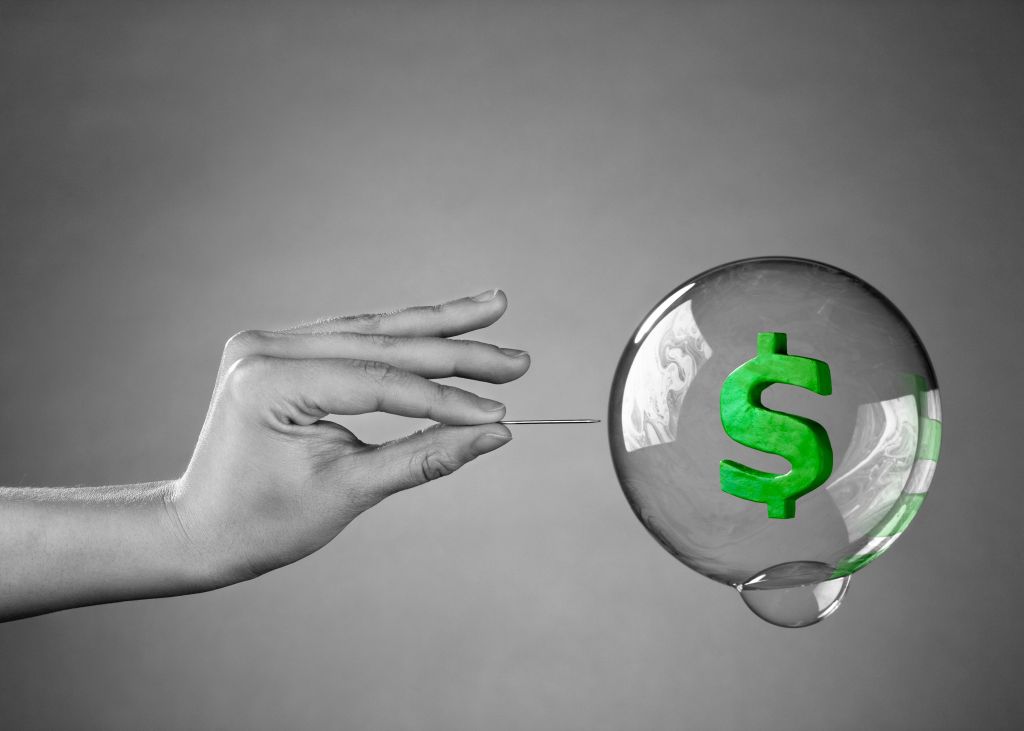
Let’s start with some basics here, an economic bubble or asset bubble (sometimes also referred to as a speculative bubble, a market bubble, a price bubble, a financial bubble, a speculative mania, or a balloon) is a situation in which asset prices appear to be based on implausible or inconsistent views about the future.

In simpler words, an economic bubble is formed due to sudden overvaluation of an asset and the later correction in its value.

So, who can make these bubbles?

Anybody, with a lot of capital at their disposal can form a bubble. This may include an individual, a company or even a group of companies who may come together to raise the value of an asset.

What good does a bubble do?

For an economy? Nothing. But for the investors, it means profits and major profits if it doesn’t get squeezed by a bigger investor (don’t know what a squeeze is? Stay tuned for further post).

How?

When a major investor or group of investors purchase a major chunk in an asset (commodity, equities, currencies, etc.) there is a sudden surge in the price of the asset, this surge is further increased by speculators in search for quick profits. When the price of the asset reaches a margin, the investor start selling the asset as rapid pace hence, making profits on their initial investments hence, bursting the bubble.

A simple recent example of bubble would be ‘BITCOIN’

BUBBLE OF BITCOIN

Here’s what the timeline of this bubble looked like:

  • December 17, 2017: bitcoin’s price briefly reaches its all time high of $19,783.06.
  • December 22, 2017, bitcoin fell below $11,000, a fall of 45% from its peak.
  • November 15, 2018, Bitcoin’s market capitalisation fell below $100 billion for the first time since October 2017 and the price of Bitcoin fell to $5,500. (Wikipedia)

F.Y.I in case you didn’t know the recession of 2008 was due to housing market bubble, where the prices of houses and their loans busted.

 I hope you liked the read, in case you didn’t I am sorry but there is no dislike button, you can always use comments though.

By Bhavik Gandhi       December 19, 2019

Economy & Stock Market: A Relationship that’s Always on the Rocks

What is stock market?

A stock market, equity market or share market is the aggregation of buyers and sellers of stocks, which represent ownership claims on businesses; these may include securities listed on a public stock market. Wikipedia.

In, other words the stock market helps investors to invest their capital in equities of companies they think will perform well. This investor may include any common person, a banker, a business man(or woman),or an international investment company, etc. There by helping the company in its endeavours.  

Whats the relation of Stock market with the Economy?

In an ideal world the stock market should be a clear representation of the economy. That is, when the general economy goes south the stock market should also go south and vice-verse.

But does it?

Not always, since we don’t live in an ideal world (sadly). The numbers of a stock market are not that reliable. The general economy of a country may be suffering a down turn ( i.e lack of business for majority of the population ) but the stock market may be at all time high. If you this resonating with India’s economy in December 19 (time of writing) then you won’t be wrong.

So when do their stars align?

Lets consider this,

A man takes his dog for a walk in a park. The dog is on a leash. The man walks straight, dog goes left and right but it still walks with the man.

One can say the man is like the economy and the dog is like the stock market. Howsoever the stock market fluctuates, in the end it has to walk along with the economy.

Why did the stock market go up in the first place, even at economy’s lows?

When the general business is low, people start to look elsewhere for quick and easy returns. Stock market is always a very attractive bet for such individuals and when this happens, all the money gets pulled out of the real markets and gets poured into stock market making the economy go down and stock prices to go up.

Hence, even if the stock market is at high and economy is at low, the stock market will return to low as well (eventually).

Honestly I can’t think of anything more for this blog. I hope you liked the read, in case you didn’t I am sorry but there is no dislike button, you can always use comments though.

By Bhavik Gandhi         December 18, 2019

Design a site like this with WordPress.com
Get started